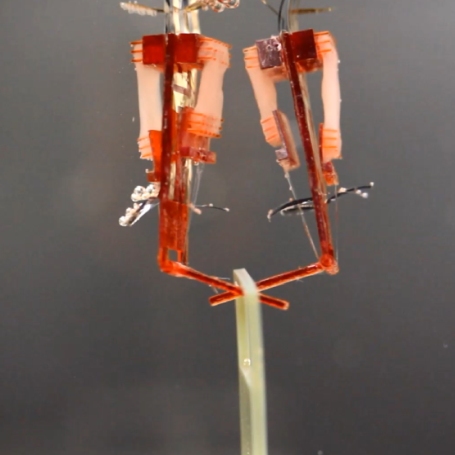
Tongue-Like Bioactuator
Xuankai Gao, Kouhei Okasaki, Hirono Ohashi, Takeshi Sakurai, Yuya Morimoto
Advanced Intelligent Systems, vol. 8 (4), e202501213, 2026
View Research Details
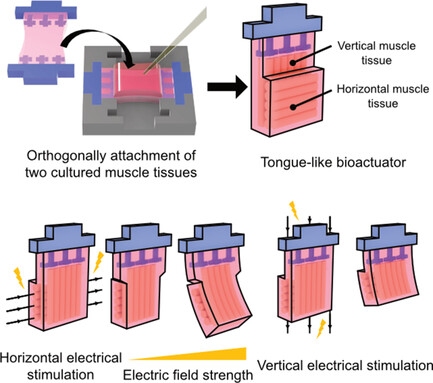
Inspired by the complex muscular architecture of the human tongue, we developed a jointless bioactuator with no artificial skeleton. The device consists of orthogonally stacked engineered skeletal muscle tissues aligned in the vertical and horizontal directions, and exploits their anisotropic responses to electrical stimulation. By precisely controlling the direction and intensity of stimulation, the actuator generates complex multidirectional motions. Horizontal stimulation induces lateral compression, while vertical stimulation produces large swinging motions accompanied by linear contraction. Trajectory analysis demonstrated that multiaxial motion can be controlled simply by adjusting the stimulation conditions. Composed entirely of muscle tissue, this device represents an innovative step toward highly flexible biohybrid robots capable of lifelike, multidirectional movement.
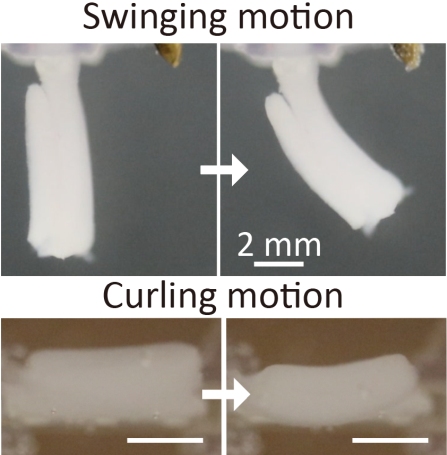
Eye-Mimicking Biohybrid Robot
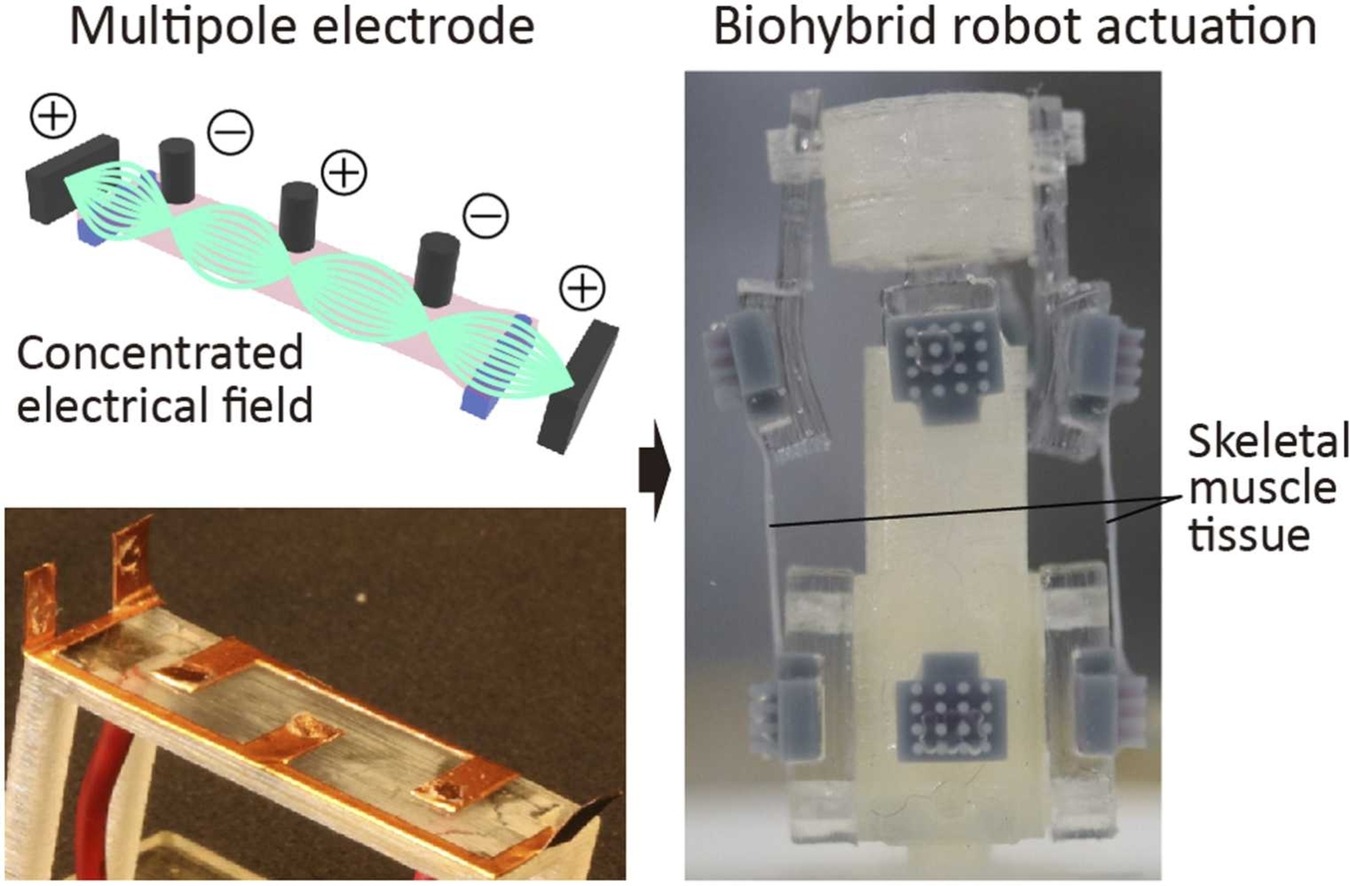
Multipole electrodes for driving biohybrid robots via selective muscle contraction
Yuya Morimoto, Hirone Yamada, Byeongwook Jo, Minghao Nie, Shoji Takeuchi
Sensors and Actuators B: Chemical, vol. 448 (2), 138924, 2026
View Research Details
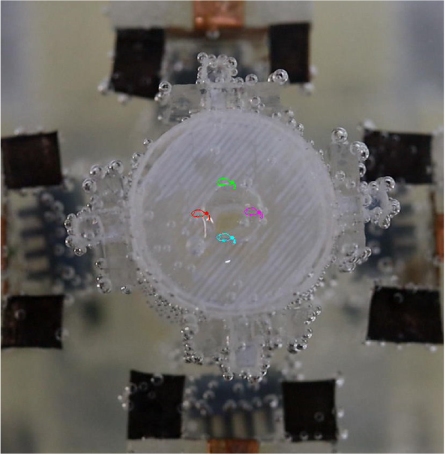
We developed a multipole electrode system that enables the selective stimulation of four individual engineered skeletal muscle tissues incorporated into a biohybrid robot. By independently controlling the four muscles, the central floating component could be tilted with two degrees of freedom. Sequential stimulation of the muscles also produced complex multidirectional motion along an elliptical trajectory. This approach is expected to provide a powerful method for increasing the degrees of freedom and functional complexity of biohybrid robots.
Biohybrid Hand Robot
Biohybrid hand actuated by multiple human muscle tissues
Xinzhu Ren, Yuya Morimoto, Shoji Takeuchi
Science Robotics, vol. 10 (99), adr5512, 2025
View Research Details
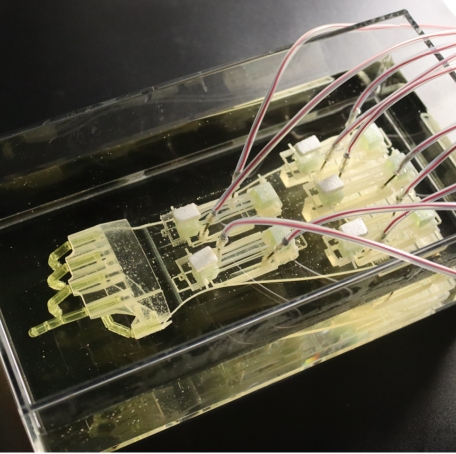
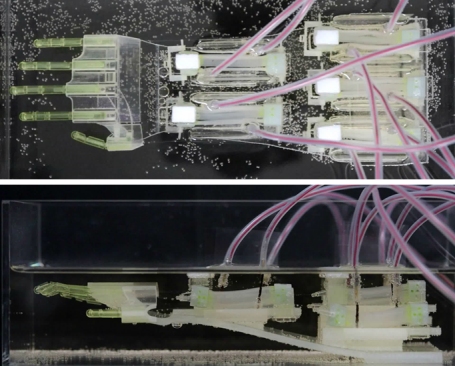
We developed an 18-cm-long biohybrid hand with multi-jointed fingers using a high-force actuator called a multiple muscle tissue actuator, or MuMuTA, composed of bundled human skeletal muscle tissues. By assembling multiple thin muscle tissues, the MuMuTA suppresses internal necrosis while producing a large contractile force of approximately 8 mN and a contraction distance of approximately 4 mm. This force is transmitted through a wire-driven mechanism, enabling independent control of all five fingers, the formation of a scissors gesture, and the manipulation of objects. This work overcomes the size and functional limitations of conventional small and simple biohybrid robots, enabling the construction of larger and more complex biological machines. Potential future applications include drug-testing models and advanced prosthetic hands.
Biohybrid Bipedal Robot
Biohybrid bipedal robot powered by skeletal muscle tissue
Ryuki Kinjo, Yuya Morimoto, Byeongwook Jo, Shoji Takeuchi
Matter, vol. 7 (3), pp. 948-962, 2024
View Research Details
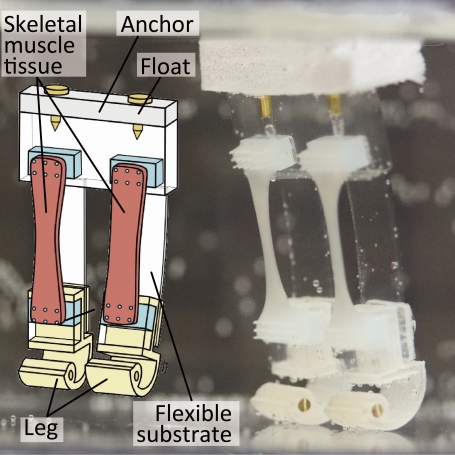
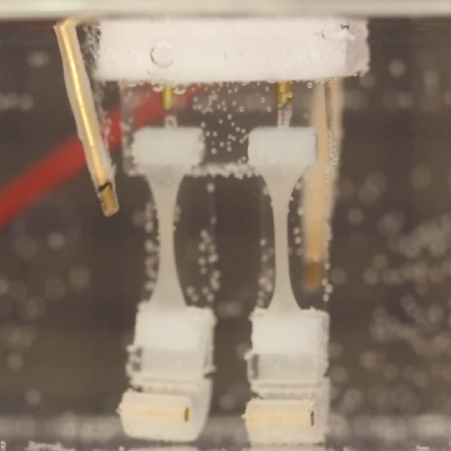
We developed a bipedal biohybrid robot powered by engineered human skeletal muscle tissues. The robot consists of a float that maintains an upright posture underwater, weighted legs, and a flexible substrate. Muscle contraction lifts one leg, while gravity and the restoring force of the flexible substrate move the robot one step forward. By electrically stimulating the left and right legs independently, the robot achieved precise turning with substantially greater maneuverability than previous biohybrid robots, with a turning index of 2.1. It also demonstrated controllable forward movement and stopping. This work is expected to contribute to understanding the complex mechanisms of biological walking and to the development of advanced soft robots and dynamic disease models for drug evaluation.
Air-Operable Biohybrid Robot
Biohybrid robot with skeletal muscle tissue covered with a collagen structure for moving in air
Yuya Morimoto, Hiroaki Onoe, Shoji Takeuchi
APL Bioengineering, vol. 4 (2), 026101, 2020
View Research Details
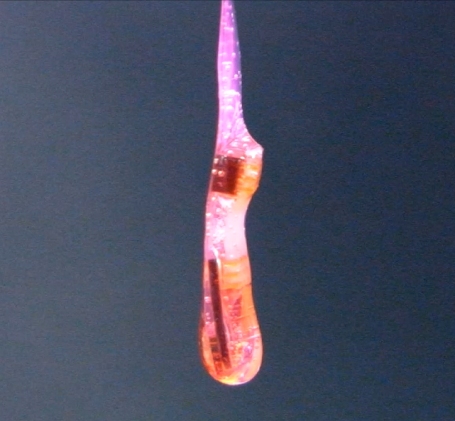
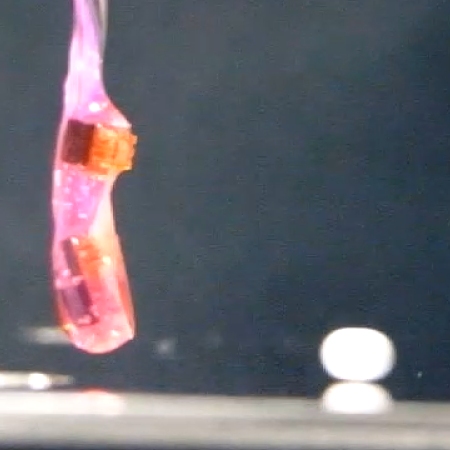
We developed a method for operating a biohybrid robot powered by engineered skeletal muscle tissue in air. Previous biohybrid robots were limited to underwater operation because their tissues dried out and became damaged in air. In this study, the muscle tissue and culture medium were enclosed within a hollow collagen structure that maintained a humid environment. This design preserved tissue viability and contractile force in air, allowing the robot to perform tasks such as pushing beads. By incorporating an internal tube for circulating culture medium, tissue dehydration was prevented and continuous operation for one hour was achieved. The collagen structure can also support the formation of cell layers on its surface, providing a promising route toward highly functional biohybrid robots that more closely resemble terrestrial organisms.
Biohybrid Robot with Antagonistic Muscles
Biohybrid robot powered by an antagonistic pair of skeletal muscle tissues
Yuya Morimoto, Hiroaki Onoe, Shoji Takeuchi
Science Robotics, vol. 3, pp. eaat4440, 2018
View Research Details
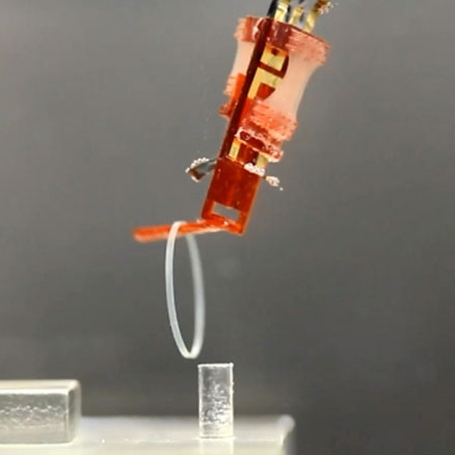
We developed a biohybrid robot with an antagonistic muscle configuration inspired by biological musculoskeletal systems. This design addresses a major limitation of muscle-powered robots: the shortening and reduced lifetime of engineered muscle tissues caused by their own passive tension. By balancing the tension between a pair of opposing muscles, excessive tissue shortening was prevented, extending the operating lifetime from several days to approximately one week. Selective contraction of each muscle also enabled large bidirectional joint rotations of approximately 90 degrees. The robot successfully performed delicate object-manipulation tasks resembling the motion of a human finger, including lifting and lowering an object. This work overcomes major limitations in the lifetime and range of motion of biohybrid robots and contributes to the development of biological machines capable of more complex movements.