Open-Air Skin Evaluation System
Open-air human skin equivalent platform enabling photobiological studies and topical product testing
Suzuha Asano, Yuya Morimoto
Biofabrication, vol. 18 (3), 035026, 2026
View Research Details
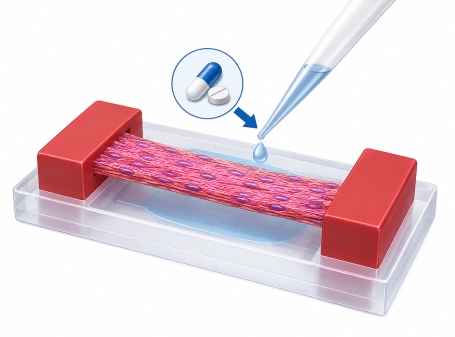
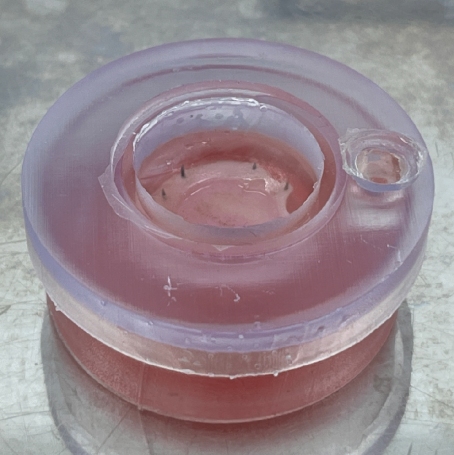
We developed an open-air culture platform that enables human skin equivalents containing melanocytes to be maintained and evaluated outside a clean-room environment. The platform exposes only the stratum corneum of the epidermis to the external environment, while the remaining regions are sealed and protected using a nylon sheet and a rubber support. This unique configuration maintains sterility while taking advantage of the skin’s natural barrier function. In proof-of-concept experiments, the platform successfully reproduced tanning responses under real-world conditions involving sunlight and wind, and enabled evaluation of the effectiveness of commercially available sunscreens. It also allowed quantitative analysis of changes such as melanin accumulation. This system provides an innovative tool for testing the safety and effectiveness of cosmetics and pharmaceuticals under more realistic environmental conditions, overcoming important limitations of conventional in vitro skin models.
Load-Programmable Muscle Training System
Ryo Mitsui, Xuankai Gao, Yuya Morimoto
Biofabrication, vol. 18 (2), 025043, 2026
View Research Details
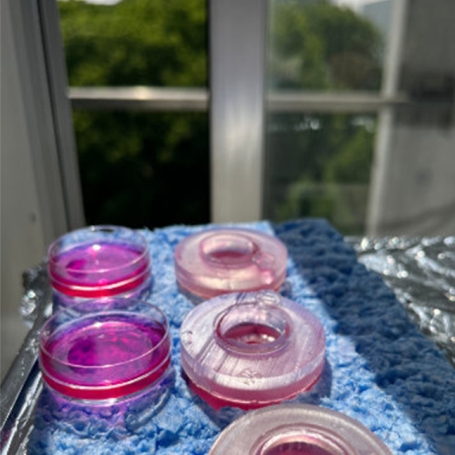
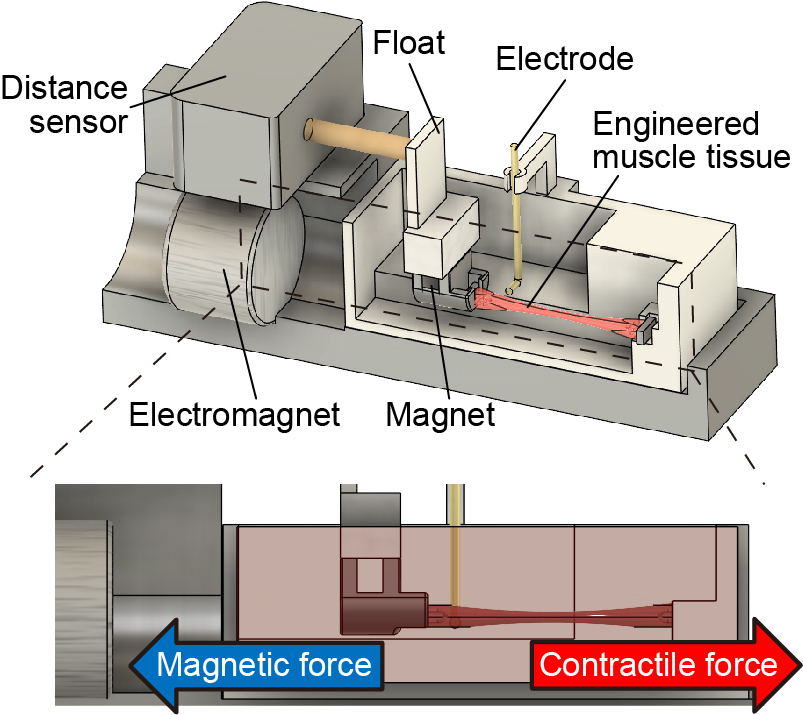
We developed an electromagnet-based training platform that enables controlled mechanical loading of engineered human skeletal muscle tissue. The system uses magnetic interactions between an external electromagnet and a permanent magnet attached to the end of the tissue, allowing the applied load to be adjusted dynamically and without physical contact. Closed-loop control using a displacement sensor enables precise regulation of the load during contraction and reproduces physiologically relevant isotonic contractions. After three days of training, moderate loading of 0.6–0.8 mN was found to enhance the contractile force and metabolic maturation of the muscle tissue. Because the system does not require the manual replacement of physical weights, it enables quantitative evaluation of how exercise intensity affects muscle at the cellular level. Potential applications include the development of rehabilitation strategies and drug-discovery studies.
Dumbbell-Based Muscle Training System
Dynamic and static workout of in vitro skeletal muscle tissue through a weight training device
(* equal contribution) Byeongwook Jo*, Kentaro Motoi*, Yuya Morimoto, Shoji Takeuchi
Advanced Healthcare Materials, vol. 20 (32), 2401844, 2024
View Research Details
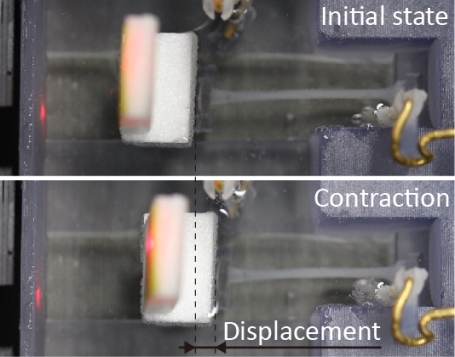
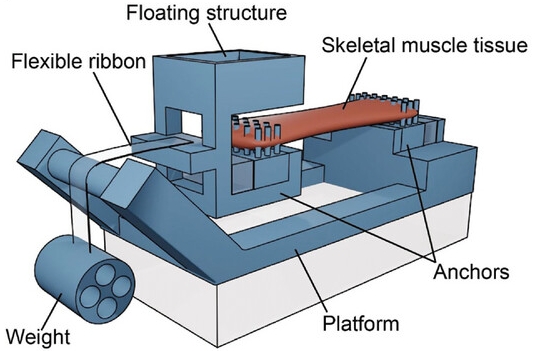
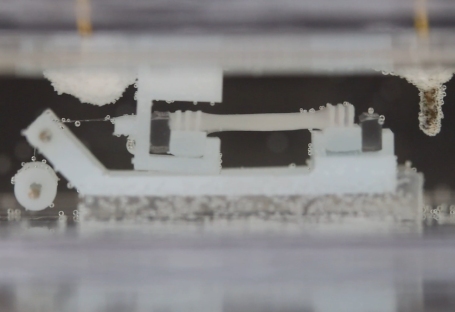
We developed a weight-training system that applies dynamic mechanical loads to engineered human skeletal muscle tissue using physical weights. The tissue is connected to a weight through a flexible ribbon and lifts the weight vertically in response to electrical stimulation. This design enables both isotonic training, in which muscle length changes during contraction, and isometric training, in which muscle length remains constant. After five days of training, isotonic exercise increased contractile force by 151% and muscle-fiber diameter by 20%, indicating enhanced tissue maturation. Glucose consumption and lactate production also increased, reproducing exercise-related metabolic responses similar to those observed in living muscle. This system enables quantitative evaluation of how exercise type and intensity affect muscle tissue at the cellular level and may contribute to rehabilitation research and drug development.
Muscle Tissue–Vascular Wall System
Yuya Morimoto, Shogo Nagata, Miki Matsumoto, Keisuke Sugahara, Shigenori Miura, Shoji Takeuchi
Sensors and Actuators B: Chemical, vol. 348, 130675, 2021
研View Research Details
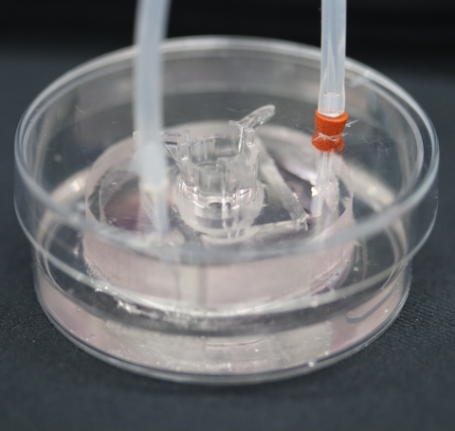
We developed a microfluidic system using a collagen vitrigel membrane to reproduce the structure and mechanical environment of the vascular wall. The device accommodates a commercially available culture insert and directly applies blood-flow-like shear stress to vascular endothelial cells cultured on the underside of the membrane. A fluid reservoir removes bubbles and controls pulsatile flow, providing a stable culture environment. Experiments confirmed that endothelial cells aligned in the direction of fluid flow. In a co-culture model with muscle cells placed on the opposite side of the membrane, the endothelial cells aligned with the flow while the muscle cells aligned perpendicular to it, reproducing the characteristic cellular organization of the vascular wall. This platform may serve as a useful tool for drug-permeability testing and physiological studies.
Cardiac Tissue Drug Evaluation System
Human induced pluripotent stem cell-derived fiber-shaped cardiac tissue on a chip
Yuya Morimoto, Saori Mori, Fusako Sakai, Shoji Takeuchi
Lab on a Chip, vol. 16, pp. 2295-2301, 2016
View Research Details
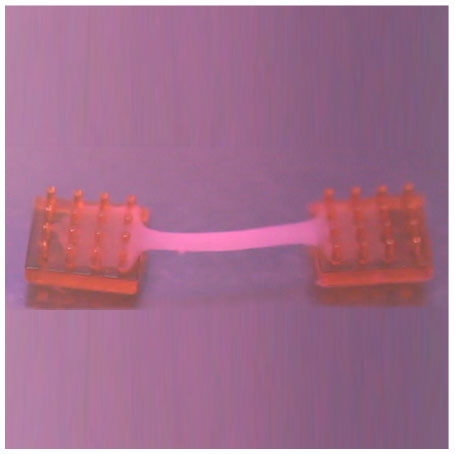
We developed a method for constructing fiber-shaped three-dimensional cardiac tissues using human induced pluripotent stem cell-derived cardiomyocytes. A PDMS stamp was used to shape the cell-containing hydrogel into a narrow fiber, promoting strong cellular alignment along the longitudinal direction and enabling efficient contractile motion. Compared with conventional two-dimensional culture, the three-dimensional structure enhanced cell–cell interactions, while the narrow tissue geometry helped prevent central necrosis and promoted tissue maturation. A substrate incorporating cantilevers enabled precise measurement of contractile force. Using this system, we successfully quantified changes in beating frequency and contractile force in response to drugs such as isoproterenol. This platform is expected to provide a useful tool for drug development and the evaluation of potential cardiac side effects.