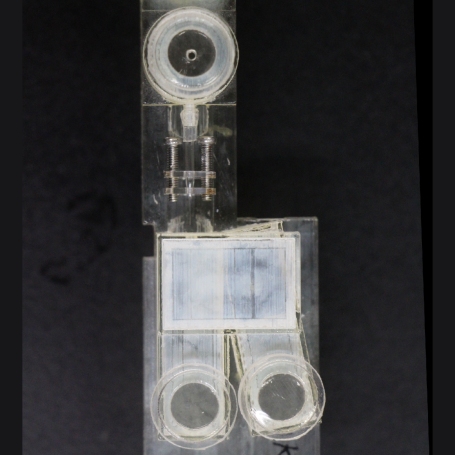
Self-Powered Glucose Sensor
Totally organic and self-powered glucose sensor based on energy-harvesting enzymatic biofuel cells
Hitomi Yahagi, Shotaro Yoshida, Shun Okada, Kan Shoji, Yuya Morimoto
Mechanical Engineering Journal, vol. 13 (5), 26-00174, 2026
View Research Details
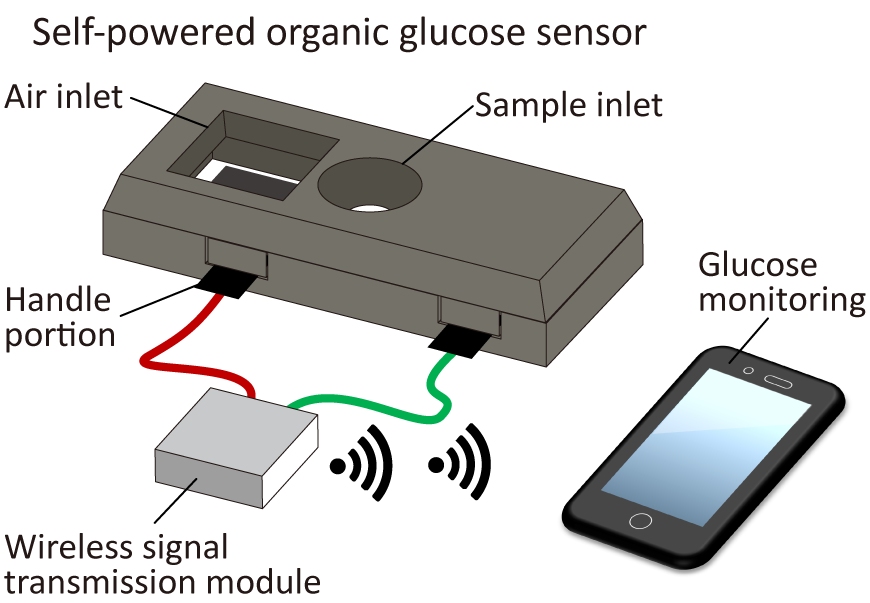
We developed a self-powered glucose sensor composed entirely of organic and polymer materials. The device functions as an enzymatic biofuel cell using enzyme-based electrodes and generates electricity through the oxidation of glucose as its fuel. Because the generated power depends on the glucose concentration within the range of 0.0–1.0 mM, the device can measure glucose levels without an external power source. Integration with a wireless transmitter enabled battery-free data transmission to a smartphone. The sensor also demonstrated a favorable response in experiments using artificial urine, indicating its potential for future non-invasive health monitoring. Its metal-free construction offers additional advantages in flexibility, biocompatibility, and environmental sustainability, making it a promising next-generation sensing device.
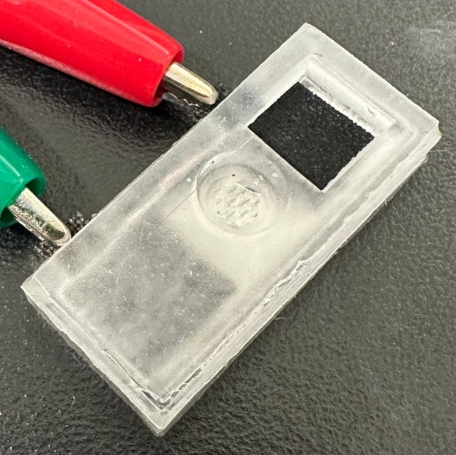
Tissue-Compatible Vacuum-Filled Electrode
Tingyu Li, Minghao Nie, Yuya Morimoto, Shoji Takeuchi
Biofabrication, vol. 16, 035022, 2024
View Research Details
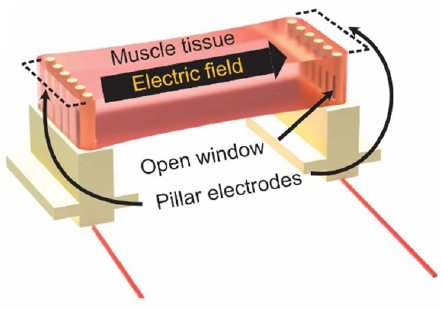
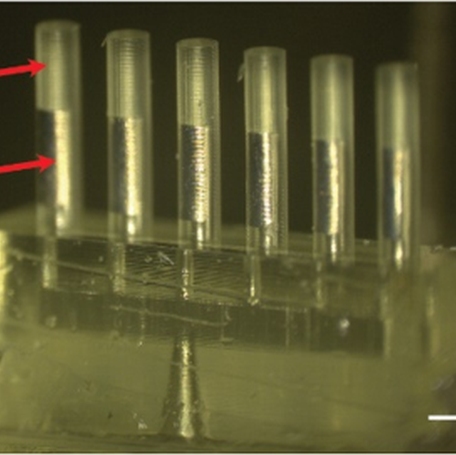
To enable precise control of biohybrid robots, we developed pillar electrodes that are embedded at both ends of engineered skeletal muscle tissues and used to drive them directly. Conventional external electrodes can unintentionally stimulate neighboring tissues because electrical signals spread through the surrounding culture medium. In this system, a low-melting-point alloy is filled into the anchors that secure the tissue, and electrical signals are delivered directly through specially designed openings. This structure suppresses the spread of the electric field and concentrates stimulation on the target tissue. As a result, we selectively contracted the intended muscle tissue without affecting adjacent tissues positioned only 4 mm away. The pillar electrodes also produced a greater contractile displacement than conventional rod-shaped gold electrodes. This technology will contribute to the development of more complex and biologically realistic biohybrid robots containing densely arranged muscle tissues.
3D-Printed Microfluidic Modules
Three-dimensional printed microfluidic modules for design changeable coaxial microfluidic devices
Yuya Morimoto, Mahiro Kiyosawa, Shoji Takeuchi
Sensors and Actuators B: Chemical, vol. 274, pp. 491-500, 2018
View Research Details
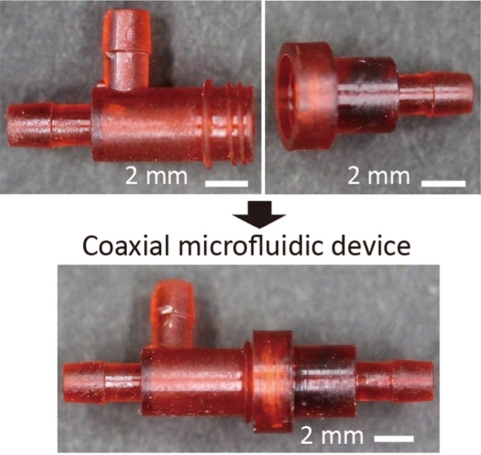
We developed screw-connectable microfluidic modules fabricated using a three-dimensional printer. By freely combining three types of modules—top, middle, and bottom units—users can construct coaxial microfluidic devices whose designs can be readily modified. The precisely aligned multilayer structure enables the stable production of uniform droplets and multilayered hydrogel fibers containing cells. Compared with conventional monolithic devices with complex geometries, the modular system is easier to fabricate, clean, and reuse. The number of layers and the dimensions of the flow paths can also be adjusted flexibly. This work provides a versatile platform for biofabrication and may contribute to the precise production of microparticles and the construction of complex three-dimensional tissues.
Centrifugal Microfluidic Device
Mass production of cell-laden calcium alginate particles with centrifugal force
Yuya Morimoto, Maiko Onuki, Shoji Takeuchi
Advanced Healthcare Materials, vol. 6, 1601375, 2017
View Research Details
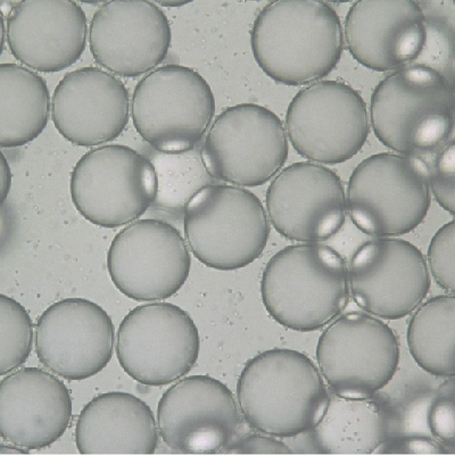
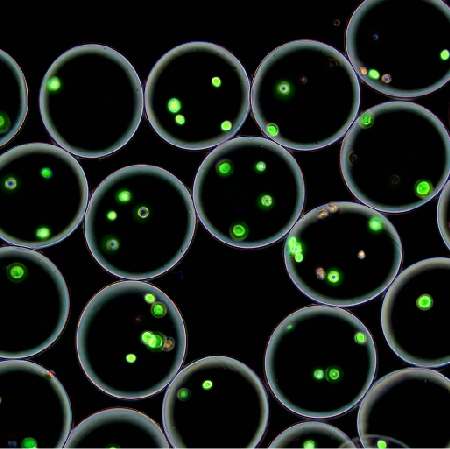
We developed an oil-free device that uses centrifugal force to produce large quantities of calcium alginate particles containing living cells. Conventional centrifugal methods suffer from unstable particle formation because particles accumulate in the collection chamber, causing the liquid level to rise. In this study, we introduced a bypass channel that removes excess liquid and maintains a constant liquid level. This design enabled the stable production of more than 45,000 monodisperse particles in four minutes. Because no oil is used, the method reduces cytotoxicity and allows cells to be encapsulated while maintaining high viability. The particles can also serve as modular building blocks for the rapid construction of complex three-dimensional tissues, including figurine-shaped structures. This technology may support future applications in drug development and regenerative medicine.